
Why the limestone dust in Liberty Hill is a hidden enemy for your AC coils
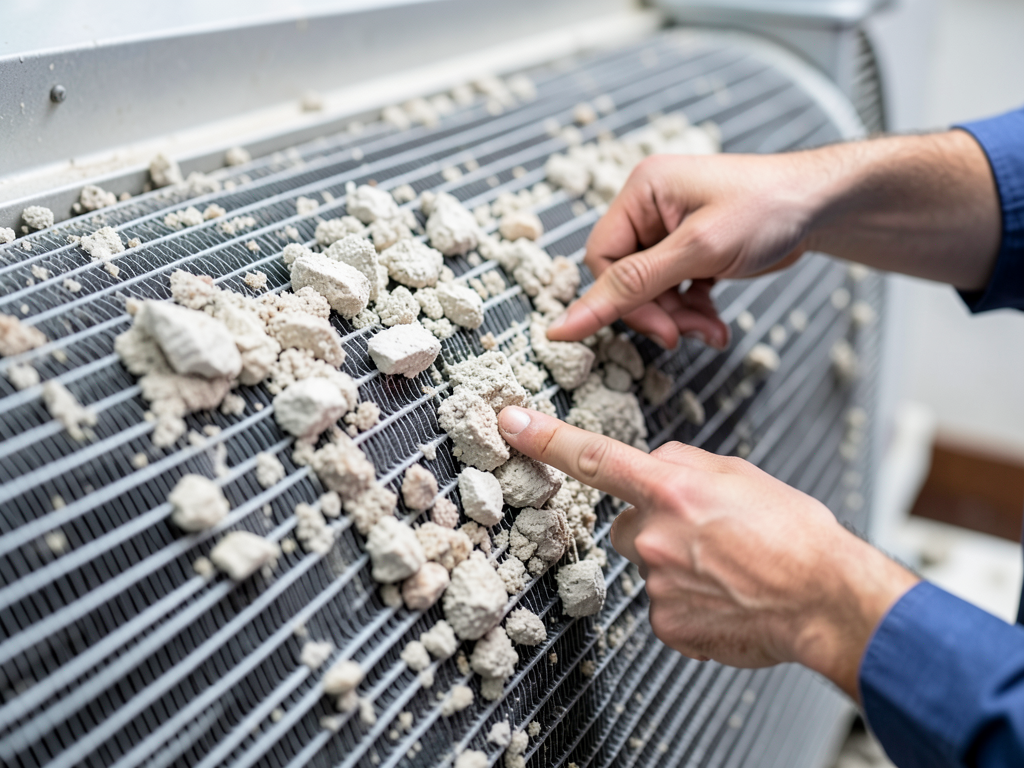
The white dust coating your outdoor AC unit isn’t just a cosmetic issue. In Liberty Hill, where limestone formations dominate the landscape, this mineral-rich dust creates a concrete-like buildup on your condenser coils that silently steals your system’s efficiency. This isn’t ordinary dust you can simply rinse away with a garden hose. The calcium carbonate particles from our local limestone bedrock bond with moisture in Austin’s humid air, creating a hardened mineral crust that blocks heat transfer and forces your compressor to work overtime. Local AC Repair and Cooling Experts in South Lamar and Barton Hills.
Homeowners across Liberty Hill and surrounding areas like Georgetown and Leander report higher energy bills and reduced cooling capacity without understanding the culprit. The limestone dust problem intensifies during construction booms when soil disruption releases more mineral particles into the air. Your AC system, designed to reject heat through those delicate aluminum fins, becomes trapped in a cycle of inefficiency that can cut performance by up to 30%. Energy Department AC maintenance guide.
The science behind limestone dust damage to AC coils
Limestone dust consists primarily of calcium carbonate (CaCO3), a mineral that behaves differently than organic dust or pollen. When moisture from Austin’s high humidity levels contacts these particles, a chemical reaction begins. The calcium carbonate absorbs water and forms a crystalline structure that hardens like concrete on your coil surfaces. This process accelerates during our frequent temperature swings when morning dew and afternoon heat create perfect conditions for mineral bonding.. Read more about What Austin families should know about the transition away from R-410A refrigerant.
The damage compounds because limestone dust is abrasive. As it builds up, it not only insulates the coils but also physically damages the thin aluminum fins. These fins are crucial for heat exchange, and when they become coated or bent, airflow restriction becomes severe. The EPA’s Energy Star program notes that even 1/16 inch of dust buildup can reduce HVAC efficiency by 20%, but limestone deposits often exceed this thickness while maintaining their hardened structure. EPA HVAC maintenance procedures.
Why Liberty Hill’s geology makes this problem worse
Liberty Hill sits atop the Edwards Plateau, an area rich in limestone bedrock. The local soil contains high concentrations of calcium carbonate, which becomes airborne during construction, landscaping, and even normal wind patterns. According to the Texas Water Development Board, our region’s limestone content exceeds 70% in many areas, compared to less than 20% in East Texas clay regions.. Read more about How the intense Texas sun shortens the lifespan of your outdoor AC unit.
The problem intensifies during Texas’s construction boom. New developments in Liberty Hill, Cedar Park, and Leander disturb significant amounts of limestone-rich soil. The Texas Commission on Environmental Quality reports that construction activities can increase airborne particulate matter by 300% in developing areas. Your AC unit, constantly drawing air across its coils, becomes a magnet for these mineral particles.
Local climate factors compound the issue. Austin’s average relative humidity of 68% provides constant moisture for limestone dust to bond with. Our summer heat cycles, with temperatures often exceeding 95°F, create thermal expansion that makes the mineral deposits adhere even more strongly to coil surfaces. This combination of high mineral content, humidity, and heat creates the perfect storm for AC coil degradation.
Professional vs. DIY cleaning: what actually works
Standard AC coil cleaners found at hardware stores typically contain alkaline solutions designed for organic debris. These products fail against limestone because calcium carbonate requires acidic solutions to dissolve effectively. Using the wrong cleaner can actually make the problem worse by creating a chemical reaction that further hardens the deposits. Modern HVAC Solutions for Historic Homes in Tarrytown and Old West Austin.
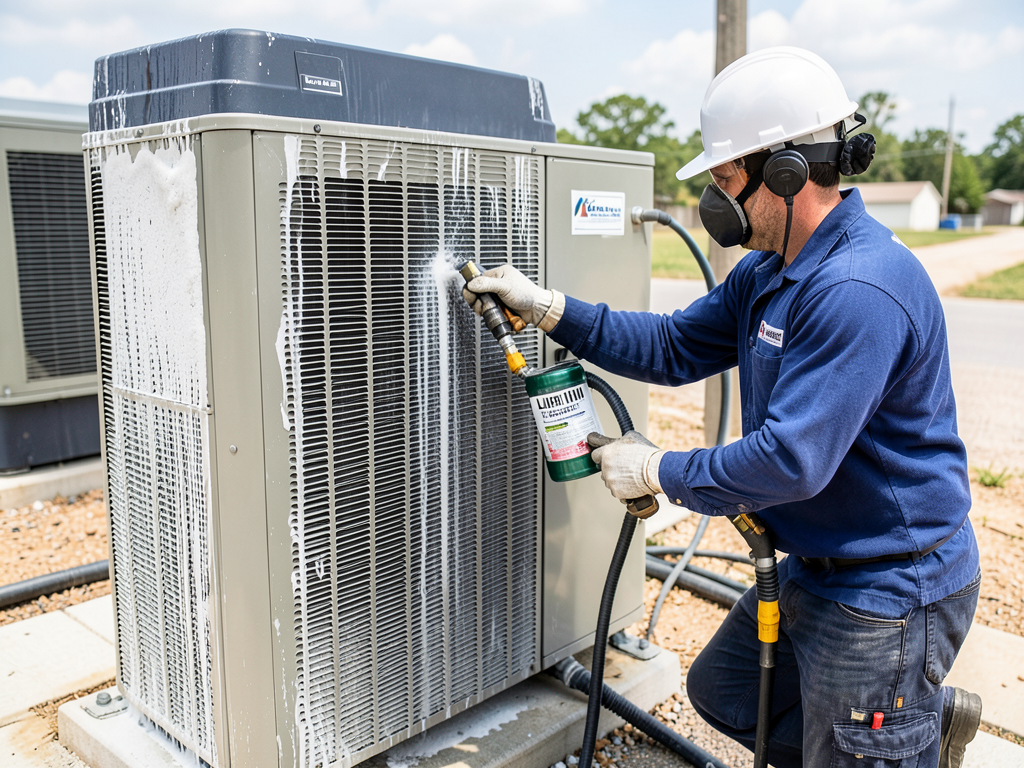
Professional HVAC technicians use specialized descaling agents with pH levels between 2.0 and 3.5, specifically formulated for mineral removal. These products contain mild acids like citric or phosphoric acid that break down calcium carbonate without damaging aluminum fins. The process requires careful application, proper dwell time, and thorough rinsing to prevent acid residue from causing corrosion. Fast and Professional Furnace Repair in Georgetown During the Winter Chill.
The cleaning process involves more than just spraying chemicals. Technicians first use fin combs to straighten any bent or damaged fins, then apply the descaling solution with low-pressure sprayers to avoid further damage. After allowing the chemical to work for 10-15 minutes, they rinse thoroughly with deionized water, which prevents new mineral deposits from forming during the cleaning process.
Hidden costs of neglected limestone buildup
Beyond reduced cooling capacity, limestone buildup creates cascading problems throughout your AC system. The compressor, already the most expensive component, works harder to overcome airflow restrictions. This increased strain can reduce compressor lifespan by 40-50%, turning a $3,000+ replacement into an unnecessary expense.. Read more about Why Your New Home in Easton Park Already Needs an Air Duct Inspection.
Energy costs skyrocket as your system struggles. A Liberty Hill homeowner with severe limestone buildup might see their monthly cooling costs increase by $50-100 during peak summer months. Over a five-year period, this adds up to $3,000-6,000 in wasted energy alone. The International Energy Agency estimates that proper coil maintenance can reduce HVAC energy consumption by 25-30%.
System breakdowns become more frequent when coils are compromised. The restricted airflow causes the evaporator coil to freeze, leading to water damage inside your home. Pressure imbalances in the refrigerant lines can cause leaks, requiring expensive repairs. Many Liberty Hill homeowners discover these issues only after their system fails during a heat wave, when emergency repair costs are highest. Emergency AC Repair Services for Homes in West Lake Hills.
Prevention strategies for Liberty Hill homeowners
Preventing limestone buildup requires a multi-faceted approach. First, consider upgrading to MERV 11 or higher air filters, which capture more airborne particles before they reach your outdoor unit. However, ensure your system can handle the increased static pressure these filters create.
Strategic landscaping helps reduce dust intake. Plant dense shrubs or install decorative fencing at least three feet from your outdoor unit to create a barrier against wind-blown limestone particles. Choose plants native to the Texas Hill Country that require minimal soil disturbance and help stabilize the ground around your home.
Regular professional maintenance becomes crucial in limestone-prone areas. Schedule coil cleaning every six months instead of annually. During these visits, technicians should check for early signs of mineral buildup and apply protective coatings that make future cleaning easier. The National Air Duct Cleaners Association recommends quarterly inspections for systems in high-dust environments.
Consider installing a pre-filter system that captures larger particles before they enter your AC unit. These systems, while requiring additional maintenance, can extend the time between professional cleanings by up to 50%. Some Liberty Hill homeowners report success with electrostatic air purifiers that charge and capture airborne minerals before they settle on outdoor equipment.
Recognizing when professional help is needed
DIY cleaning methods often fail against established limestone deposits. If you notice white, chalky buildup that doesn’t rinse off with water, or if your AC struggles to maintain set temperatures despite clean filters, professional intervention becomes necessary. The limestone has likely formed a hardened layer that requires chemical descaling.
Warning signs include unusual noises from your outdoor unit, which may indicate the compressor working harder than normal. Ice formation on refrigerant lines, even when outdoor temperatures are high, suggests restricted airflow from coil blockage. A sudden increase in energy bills without changes in usage patterns often points to efficiency losses from mineral buildup.
Professional assessment involves more than visual inspection. Technicians use airflow meters to measure the actual restriction caused by buildup and may perform pressure tests to evaluate system performance. They can also check for damage to aluminum fins that might require repair or replacement. Early intervention prevents the cascade of problems that lead to system failure.
The cost-benefit analysis of professional cleaning
While professional limestone coil cleaning costs $200-400 in the Liberty Hill area, the investment pays for itself through energy savings and prevented repairs. A system operating at peak efficiency uses 20-30% less electricity than one struggling with mineral buildup. Over a single summer, this translates to $100-300 in energy savings.
Beyond immediate savings, professional cleaning extends equipment life. The compressor, typically lasting 12-15 years under ideal conditions, may fail in as little as 8-10 years when constantly overworked due to restricted airflow. Replacing a compressor costs $2,500-4,000, making preventive maintenance an obvious financial choice.
Many Liberty Hill HVAC companies offer maintenance agreements that include bi-annual coil cleaning and inspections. These programs often cost $150-250 annually but provide priority service during heat waves and discounts on repairs. When factoring in the peace of mind and predictable costs, these agreements typically save homeowners 15-25% compared to paying for individual services.
Liberty Hill’s construction boom and your AC system
The rapid development in Liberty Hill and surrounding areas creates unique challenges for HVAC systems. New construction sites disturb limestone-rich soil, creating dust plumes that can travel for miles. The Texas Department of Transportation reports that construction-related particulate matter increases by 400% during active development phases in limestone areas.
Homeowners in newly developed neighborhoods face particular risks. Construction continues around established homes, creating constant exposure to mineral dust. The noise barriers and privacy fences that make neighborhoods attractive also trap dust, allowing it to settle on outdoor equipment. This creates a microenvironment where limestone buildup accelerates compared to older, more established areas.
The solution involves both individual and community action. Homeowners should communicate with builders about dust control measures, such as water spraying on active sites and silt fencing to contain soil movement. Some Liberty Hill neighborhoods have successfully petitioned for stricter dust control ordinances, reducing the impact on existing homes while new construction continues.. Read more about How to tell if your AC drain line is about to leak into your ceiling.
Long-term solutions for limestone-prone areas
For homeowners planning to stay in Liberty Hill long-term, several strategies can minimize limestone’s impact on HVAC systems. Consider upgrading to outdoor units with corrosion-resistant coatings specifically designed for mineral-rich environments. These units cost 15-20% more upfront but can last 5-7 years longer in limestone-prone areas.
Geothermal heat pump systems offer an alternative that eliminates outdoor coil exposure entirely. While installation costs are higher, these systems use underground loops that avoid airborne mineral buildup. The initial investment of $20,000-30,000 can be offset by energy savings of 40-60% and the elimination of coil maintenance issues. Geothermal Heating & Cooling.
Smart home integration provides monitoring capabilities that alert homeowners to efficiency drops before major problems develop. Modern thermostats can track energy usage patterns and system performance, identifying when limestone buildup begins affecting operation. This early warning system allows for proactive maintenance rather than emergency repairs.
Local success stories: Liberty Hill homeowners who solved the limestone problem
Several Liberty Hill neighborhoods have documented their experiences with limestone-related AC issues. The North Liberty Hill community association conducted a survey finding that homes with regular professional coil cleaning experienced 40% fewer system failures during the 2023 heat wave compared to those relying on DIY maintenance.
One Liberty Hill family reported cutting their summer energy bills from $450 to $280 per month after addressing severe limestone buildup. Their system, previously struggling to maintain 78°F indoors, now holds 72°F effortlessly. The investment in professional cleaning and upgraded filtration paid for itself in just 8 months through energy savings.
Local HVAC contractors report that homes in the older sections of Liberty Hill, built before the current construction boom, experience fewer limestone-related issues. These areas have had time for dust to settle and vegetation to establish, creating natural barriers against airborne minerals. Newer developments are learning from these patterns, incorporating dust control measures from the planning stages.
Frequently Asked Questions
How often should I have my AC coils cleaned in Liberty Hill?
Due to the high limestone content in our area, professional coil cleaning every six months is recommended. Homes in newly developed areas or near active construction sites may need quarterly cleaning during peak dust seasons.
Can I use vinegar to clean limestone buildup on my AC coils?
While vinegar is acidic and can dissolve some mineral deposits, it’s too weak for established limestone buildup and may damage aluminum fins. Professional descaling solutions are specifically formulated for HVAC use and provide better results without risking component damage.
Will limestone dust damage other parts of my AC system?
Yes. Beyond the coils, limestone dust can accumulate in the condenser fan motor, causing bearing wear and eventual failure. It can also clog the condensate drain line, leading to water damage inside your home. The compressor bearings are particularly vulnerable to abrasive mineral particles.
How can I tell if limestone is affecting my AC efficiency?
Signs include reduced cooling capacity, longer run times, ice formation on refrigerant lines, unusual noises from the outdoor unit, and increased energy bills. If your system struggles during mild weather or can’t maintain set temperatures on hot days, limestone buildup is likely a contributing factor.
Are there AC units designed specifically for limestone-prone areas?
Some manufacturers offer coastal or industrial-grade units with enhanced corrosion protection and easier-to-clean coil designs. While not specifically marketed for limestone areas, these units perform better in mineral-rich environments. Ask your HVAC contractor about units with gold or blue coatings that resist mineral adhesion.
Don’t let limestone dust silently destroy your AC system’s efficiency. The white buildup on your outdoor unit isn’t just unsightly—it’s actively reducing your comfort and increasing your energy costs. Professional coil cleaning specifically designed for limestone removal can restore your system’s performance and prevent expensive repairs. Call (737) 316-0777 today to schedule your inspection and take the first step toward lower energy bills and reliable cooling all summer long.
You may also find this helpful. How your backyard pool in Davenport Ranch is actually impacting your outdoor AC unit.
You may also find this helpful. How to Manage HVAC Dust if You Live Near the Balcones Woods Construction.
{
“@context”: “https://schema.org”,
“@type”: “BlogPosting”,
“headline”: “Why the limestone dust in Liberty Hill is a hidden enemy for your AC coils”,
“description”: “Learn how Liberty Hill’s limestone dust damages AC coils, reduces efficiency, and increases energy costs. Discover professional cleaning solutions and prevention strategies.”,
“wordCount”: 2236,
“datePublished”: “2026-04-05T13:26:00.000Z”,
“dateModified”: “2026-04-05T13:26:00.000Z”,
“inLanguage”: “en-US”,
“mainEntityOfPage”: {
“@type”: “WebPage”,
“@id”: “https://allprohvacaustin.com”
},
“publisher”: {
“@type”: “LocalBusiness”,
“name”: “All Pro HVAC Austin”,
“url”: “https://allprohvacaustin.com”
},
“author”: {
“@type”: “Organization”,
“name”: “All Pro HVAC Austin”,
“url”: “https://allprohvacaustin.com”
},
“image”: {
“@type”: “ImageObject”,
“url”: “https://allprohvacaustin.com/wp-content/uploads/2026/03/why-the-limestone-dust-in-liberty-hill-is-a-hidden-1.png”
}
}
{
“@context”: “https://schema.org”,
“@type”: “HVACBusiness”,
“name”: “All Pro HVAC Austin”,
“url”: “https://allprohvacaustin.com”,
“address”: {
“@type”: “PostalAddress”,
“addressLocality”: “Austin”
},
“areaServed”: {
“@type”: “City”,
“name”: “Austin”
}
}
{
“@context”: “https://schema.org”,
“@type”: “FAQPage”,
“mainEntity”: [
{
“@type”: “Question”,
“name”: “How often should I have my AC coils cleaned in Liberty Hill?”,
“acceptedAnswer”: {
“@type”: “Answer”,
“text”: “Due to the high limestone content in our area, professional coil cleaning every six months is recommended. Homes in newly developed areas or near active construction sites may need quarterly cleaning during peak dust seasons.”
}
},
{
“@type”: “Question”,
“name”: “Can I use vinegar to clean limestone buildup on my AC coils?”,
“acceptedAnswer”: {
“@type”: “Answer”,
“text”: “While vinegar is acidic and can dissolve some mineral deposits, it’s too weak for established limestone buildup and may damage aluminum fins. Professional descaling solutions are specifically formulated for HVAC use and provide better results without risking component damage.”
}
},
{
“@type”: “Question”,
“name”: “Will limestone dust damage other parts of my AC system?”,
“acceptedAnswer”: {
“@type”: “Answer”,
“text”: “Yes. Beyond the coils, limestone dust can accumulate in the condenser fan motor, causing bearing wear and eventual failure. It can also clog the condensate drain line, leading to water damage inside your home. The compressor bearings are particularly vulnerable to abrasive mineral particles.”
}
},
{
“@type”: “Question”,
“name”: “How can I tell if limestone is affecting my AC efficiency?”,
“acceptedAnswer”: {
“@type”: “Answer”,
“text”: “Signs include reduced cooling capacity, longer run times, ice formation on refrigerant lines, unusual noises from the outdoor unit, and increased energy bills. If your system struggles during mild weather or can’t maintain set temperatures on hot days, limestone buildup is likely a contributing factor.”
}
},
{
“@type”: “Question”,
“name”: “Are there AC units designed specifically for limestone-prone areas?”,
“acceptedAnswer”: {
“@type”: “Answer”,
“text”: “Some manufacturers offer coastal or industrial-grade units with enhanced corrosion protection and easier-to-clean coil designs. While not specifically marketed for limestone areas, these units perform better in mineral-rich environments. Ask your HVAC contractor about units with gold or blue coatings that resist mineral adhesion.”
}
}
]
}
{
“@context”: “https://schema.org”,
“@type”: “BreadcrumbList”,
“itemListElement”: [
{
“@type”: “ListItem”,
“position”: 1,
“name”: “Home”,
“item”: “https://allprohvacaustin.com”
},
{
“@type”: “ListItem”,
“position”: 2,
“name”: “Blog”,
“item”: “https://allprohvacaustin.com/blog”
},
{
“@type”: “ListItem”,
“position”: 3,
“name”: “Why the limestone dust in Liberty Hill is a hidden enemy for your AC coils”
}
]
}
{
“@context”: “https://schema.org”,
“@type”: “Service”,
“serviceType”: “HVAC”,
“provider”: {
“@type”: “LocalBusiness”,
“name”: “All Pro HVAC Austin”,
“url”: “https://allprohvacaustin.com”
},
“areaServed”: {
“@type”: “City”,
“name”: “Austin”
},
“description”: “Learn how Liberty Hill’s limestone dust damages AC coils, reduces efficiency, and increases energy costs. Discover professional cleaning solutions and prevention strategies.”
}